Nutrition
Calories In vs. Calories Out: The Science Behind Sustainable Weight Loss
By Get Up & Start · July 28, 2026
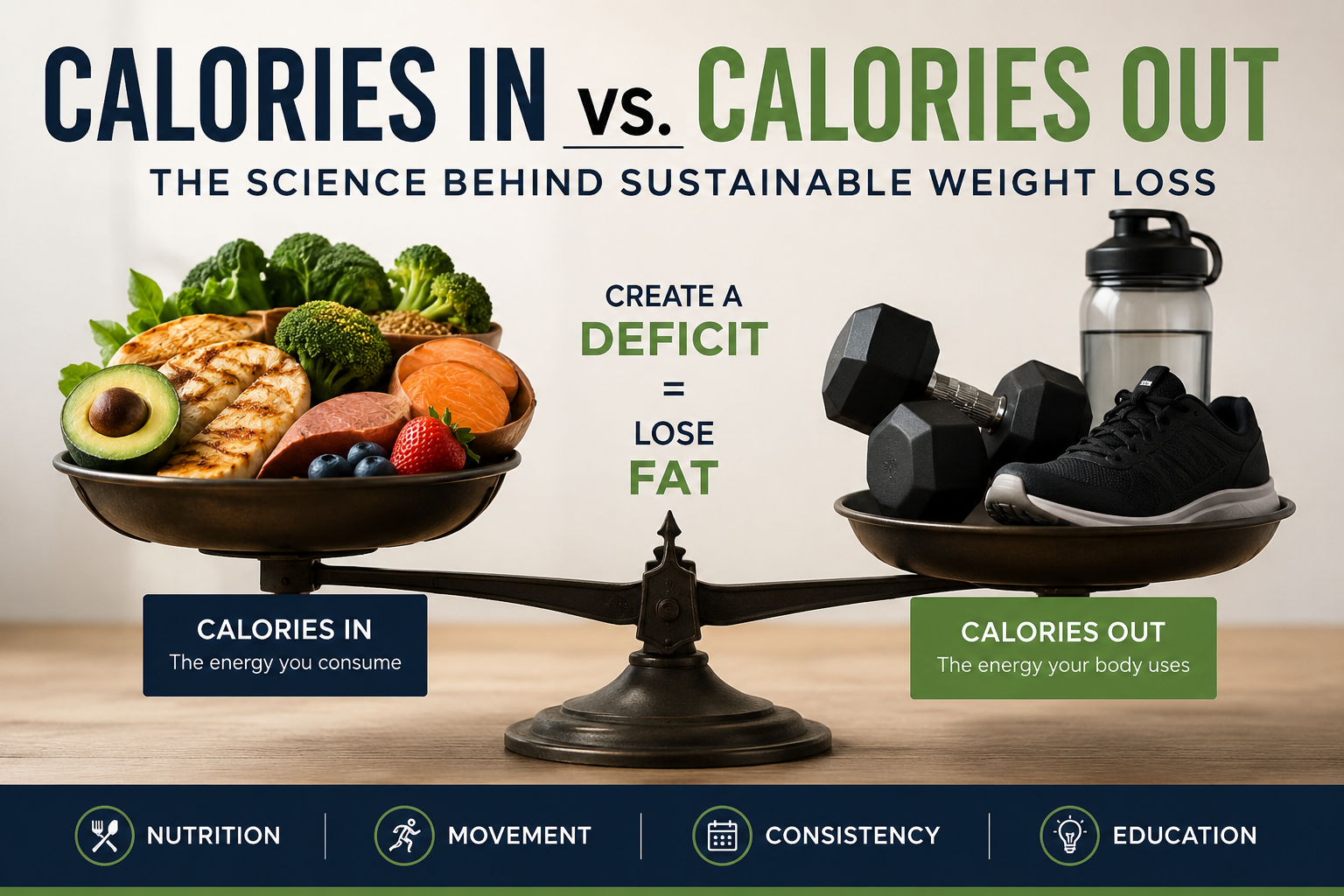
Calories In vs. Calories Out: The Truth Behind Weight Loss
If you've spent any time researching weight loss online, you've probably seen people arguing about Calories In vs. Calories Out (often called CICO).
Some people claim it's the only thing that matters.
Others insist it doesn't work because of hormones, insulin, metabolism, or genetics.
So who's right?
The truth is that Calories In vs. Calories Out is the foundation of fat loss, but understanding how it works—and why it sometimes feels like it isn't working—is what separates successful long-term weight loss from constant frustration.
Let's break it down.
What Does Calories In vs. Calories Out Mean?
At its simplest, Calories In vs. Calories Out means:
Calories In = the energy you consume from food and drinks. Calories Out = the energy your body burns throughout the day.
When you consistently consume fewer calories than your body burns, your body must make up the difference by using stored energy—primarily body fat.
That's called a calorie deficit, and it's the only known physiological mechanism by which body fat is lost.
The important thing to understand is that this isn't a diet.
It's simply how the human body manages energy.
Every successful diet—from keto to intermittent fasting to Weight Watchers—works by helping people create a calorie deficit, even if they don't realize it.
Where Do Your Calories Go?
Most people think exercise burns the majority of their calories.
In reality, that's only one piece of the puzzle.
Your daily energy expenditure is made up of several components:
Basal Metabolic Rate (BMR)
This is the energy your body uses just to keep you alive.
Breathing.
Pumping blood.
Maintaining body temperature.
Supporting your organs.
For most people, this is the largest portion of calories burned each day.
Thermic Effect of Food (TEF)
Digesting and processing food also requires energy.
Protein has the highest thermic effect, which is one reason high-protein diets can be so beneficial during weight loss.
Physical Activity
This includes planned exercise like strength training, running, cycling, or sports.
While important for overall health, exercise usually burns fewer calories than most people expect.
Daily Movement (NEAT)
Walking around the house.
Doing chores.
Standing at work.
Taking the stairs.
Parking farther away.
Playing with your kids.
These everyday movements often burn hundreds of calories each day and are one of the reasons we place such a strong emphasis on walking at Get Up & Start.
Why People Think Calories In vs. Calories Out Doesn't Work
One of the biggest reasons people become frustrated is because they expect the scale to move in a perfectly straight line.
Unfortunately, that's not how the human body works.
Your weight naturally fluctuates because of:
Water retention Sodium intake Carbohydrate intake Hormonal changes Stress Digestive contents Sleep quality
It's completely normal for the scale to increase by several pounds overnight without gaining any meaningful body fat.
That's why we encourage our clients to focus on long-term trends rather than day-to-day fluctuations.
Fat loss is slow.
Water weight is fast.
Understanding the difference can save you from giving up too early.
What About Hormones and Medical Conditions?
Hormones absolutely matter.
Medical conditions like hypothyroidism, Hashimoto's disease, polycystic ovary syndrome (PCOS), and certain medications can influence appetite, energy levels, water retention, and how many calories you naturally burn.
However, these conditions don't change the basic principle of energy balance.
Instead, they can change how difficult it is to create and maintain a calorie deficit.
For example, someone with a slower metabolism may need fewer calories to lose weight than someone of the same size without that condition.
That's one reason personalized coaching can be so valuable.
The goal isn't to fight your body.
It's to understand it and build a plan that works for your unique situation.
Why We Don't Believe in "Good" and "Bad" Foods
One of the biggest mistakes people make is believing they must completely eliminate their favorite foods to lose weight.
The truth is that no single food determines whether you lose or gain body fat.
Overall eating habits matter far more than one meal or one snack.
At Get Up & Start, we believe learning how to fit the foods you enjoy into your calorie and protein goals creates a much more sustainable lifestyle than trying to avoid them forever.
Because if your plan only works when life is perfect, it probably won't work for very long.
Why Walking and Strength Training Matter
If a calorie deficit causes fat loss, does that mean exercise isn't important?
Not at all.
Walking helps increase daily calorie expenditure while being low-impact, easy to recover from, and sustainable for almost everyone.
Strength training helps preserve muscle while you're losing weight.
Together, they help improve body composition, support long-term health, and make maintaining your results much easier.
That's why these two habits form the foundation of our coaching philosophy.
The Goal Isn't Just Losing Weight
Anyone can lose weight for a few weeks.
The real challenge is keeping it off.
That's why we focus on education instead of strict meal plans.
We want you to understand:
How many calories your body needs. Why protein matters. How to build balanced meals. How to enjoy holidays and vacations without guilt. How to make progress even when life gets busy.
Because the goal isn't to help you lose weight once.
It's to help you build the knowledge and habits that allow you to keep it off.
Final Thoughts
Calories In vs. Calories Out isn't a fad.
It's not a diet.
It's the scientific principle that explains how body weight changes over time.
Once you understand that principle, you can stop chasing miracle products and start focusing on the habits that actually make a difference.
Weight loss doesn't have to be complicated.
It requires consistency, patience, and a plan you can realistically follow.
That's exactly what we help our clients build.
Ready to Take Control of Your Weight Loss?
If you're tired of confusing nutrition advice and want a personalized plan built around your lifestyle—not someone else's—book a free consultation today.
We'll help you understand your maintenance calories, calculate your nutrition goals, and build a sustainable strategy that helps you take your life back.